
Homeowner guide
Repair or replace? How to tell when your roof still has life left
Every roofing company has an incentive to sell you a replacement. Here is the framework we actually use on-site — including the cases where we tell homeowners to keep the roof they have and spend a tenth as much.
Test one: the age test
In Ontario's freeze-thaw climate, architectural asphalt realistically delivers 20 to 28 years, three-tab closer to 15 to 20, and metal 40 to 60. Age alone does not condemn a roof, but it sets the ceiling on how much repair money is worth spending.
| Roof age | Default posture | Why |
|---|---|---|
| Under 10 years | Repair | Failures at this age are installation or flashing defects, not wear. |
| 10–17 years | Repair, plan ahead | Fix the issue, budget the replacement for the next 5–8 years. |
| 18–25 years | Case by case | Depends on condition, deck and how many repairs you have already made. |
| 25+ years | Replace | Repair money is being spent on an asset that is already finished. |
Test two: is the problem local or everywhere?
One leak at one chimney is a flashing job. Three leaks in three unrelated areas is a system telling you it is done. Walk the perimeter with binoculars and look for whether the symptoms cluster or spread.
- Local: one valley, one skylight, one pipe boot, a strip of wind-lifted shingles.
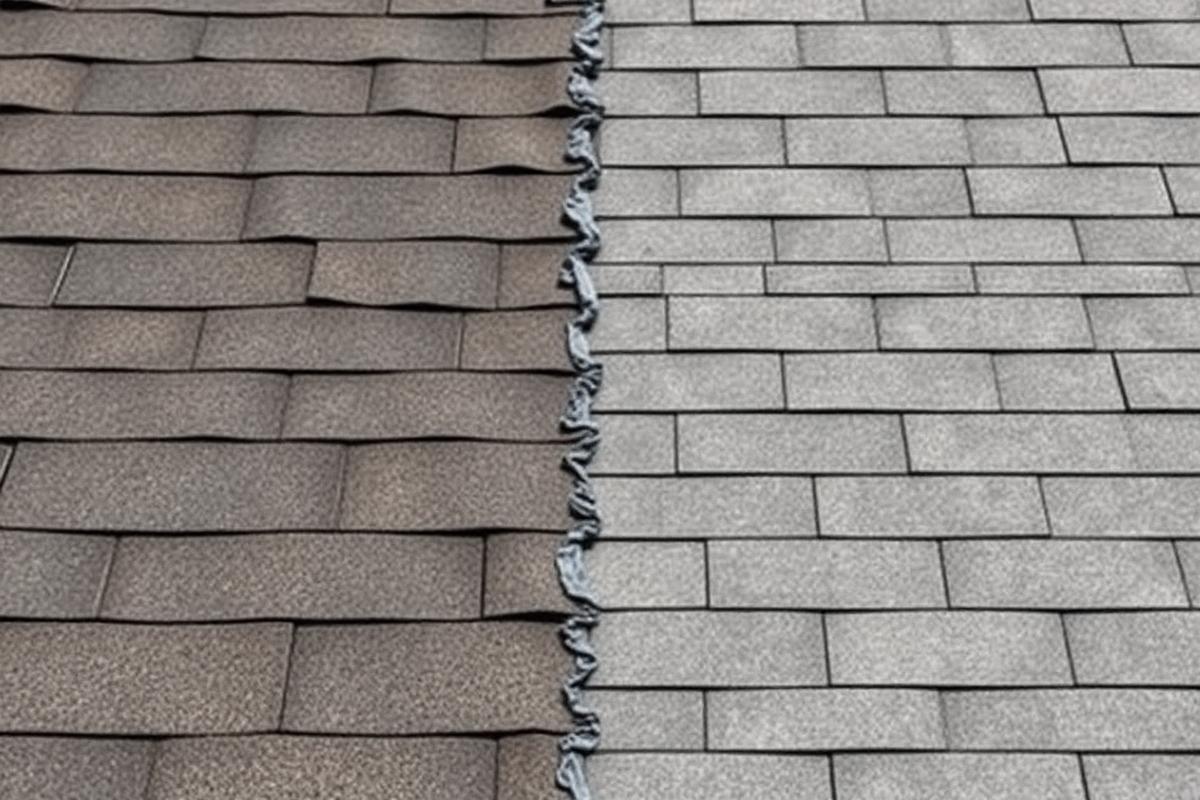
- Systemic: widespread curling and cupping at the edges, bald patches across multiple slopes, granules filling the gutters every rain.
- Structural: any visible sag or dip in the roof plane, which means the deck or framing is compromised.
Shingles that crack when lifted
A shingle that snaps instead of flexing has lost its oils. Once that is true across the roof, individual repairs stop holding because you cannot lift a course without breaking it.
Test three: the deck test
The plywood or plank deck under the shingles is the part nobody sees and the part that decides the price. Soft or spongy sections underfoot, delaminated plywood, and long-term staining on the attic side all mean the deck needs replacement — and once you are replacing deck, you are already in a tear-off.
Test four: the money test
Divide the cost of each option by the years it realistically buys. A $1,200 repair that gets you four more seasons is $300 a year. A $12,000 replacement with a 25-year life is under $500 a year and it resets the clock, warranty and insurability. When the repair number climbs past about 30% of the replacement cost, the repair stops making sense.
If your roof still has life in it, we will quote the repair and tell you to call us again in a few years. That is the whole business model.
The third option most people miss
A large share of the roofs we are asked to replace do not need shingles — they need ventilation. Balanced soffit intake and ridge exhaust, air sealing at attic penetrations and topped-up insulation typically cost a fraction of a replacement, and they stop the overheating and condensation that is killing the shingles early.
- Blocked soffit vents buried by blown-in insulation.
- Bathroom or dryer fans terminating in the attic instead of outdoors.
- Exhaust venting without matching intake, which pulls conditioned air out of the house.
What to do next
- Run the four tests before you take a quote: age, pattern, deck, money.
- Ask any contractor to photograph the deck and attic, not just the shingles.
- Get a ventilation assessment as part of the estimate — it is often the real fix.
- If replacement is right, book in shoulder season for better scheduling.